

On December 3, 2025, the President of the Republic submitted to the Senate a bill to amend the Federal Labor Law (the “Draft Decree”), which may be consulted here.
I. General Scope
The main purpose of the Draft Decree is to reduce the weekly workweek from 48 to 40 hours through a gradual implementation scheme that would begin on May 1, 2026 and conclude in 2030. In addition, the Draft Decree seeks to: (i) amend the regime applicable to overtime, (ii) incorporate new employer obligations, and (iii) modify the concepts of employer and workday.
II. Reduction of the workday
The Ley Federal del Trabajo (Federal Labor Law, “LFT”), currently provides for a maximum of 48 weekly hours (8 daytime hours over 6 days), a weekly work schedule that has been in force since 1917. Through the Draft Decree, the following changes are proposed:
- Establishment of a new maximum limit of 40 hours per week for the regular workday.
- The current daily limits (8 daytime hours, 7 nighttime hours, 7.5 mixed hours) would be maintained, but now aligned with the new weekly cap.
- Introduction of the possibility for the workday to be distributed by mutual agreement between employer and employee.
- Implementation of a gradual reduction of the weekly workday as follows:

III. Overtime Regime
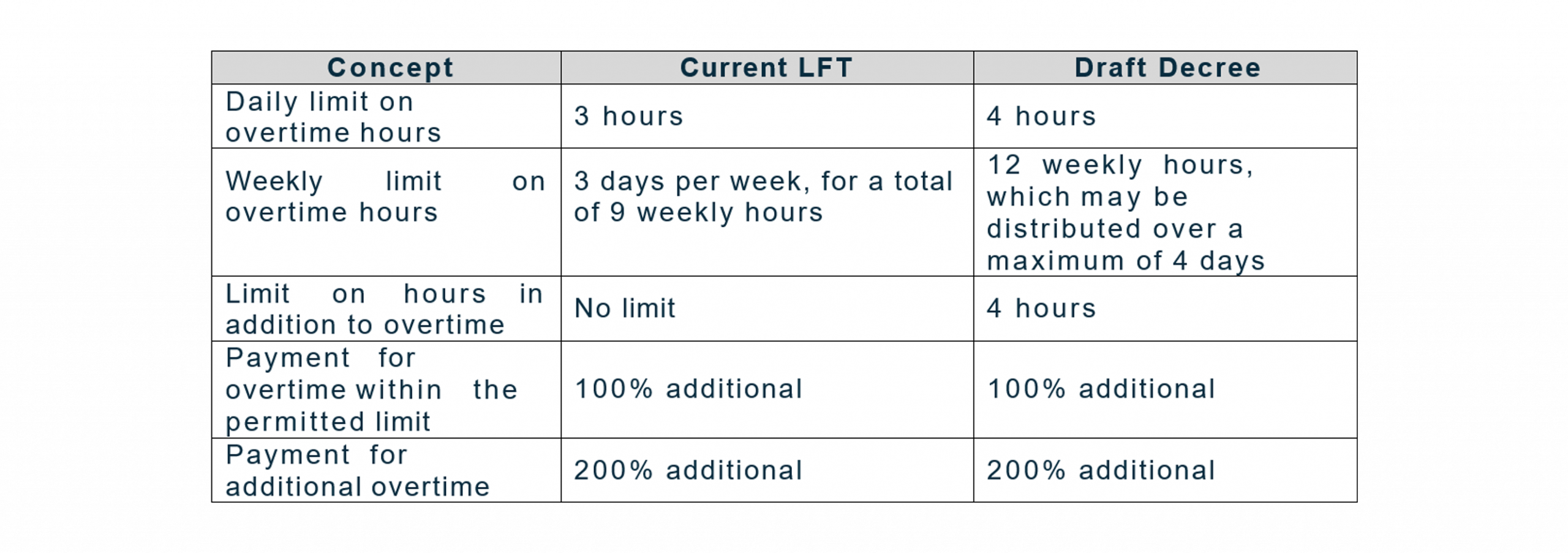
With respect to overtime work, the Draft Decree eliminates the current regime, which allows employees to work up to 3 hours of overtime per day, on a maximum of 3 days per week, for a total of 9 overtime hours, which must be paid at 100% of the regular wage. In addition, the current rule provides that the employer must pay 200% of the regular wage for overtime beyond that limit, without prejudice to the penalties set forth in the law.
The Draft Decree, in turn, establishes a new model that limits overtime to 12 hours per week, which may be distributed in workdays of up to 4 overtime hours, on a maximum of 4 days per week, and which must be paid at 100% of the regular wage.
With respect to extended overtime, the Draft Decree caps such additional time at 4 extra hours per week, which must be paid at 200%.
It is important to note that the Draft Decree prohibits the sum of the regular workday, overtime and additional overtime from exceeding 12 hours in a single day, which constitutes a new legal safeguard intended to prevent excessive workdays.
IV. New concepts
The Draft Decree also amends the definition of certain key concepts in the FLL:
- For the first time, it expressly incorporates the definition of “Employer or
Employing Person” (“Patrón or Persona Empleadora”), understood as the
individual or legal entity that hires one or more workers to perform subordinated
activities in exchange for remuneration.
This new definition strengthens clearer and more inclusive language and helps to more precisely allocate responsibilities, particularly in complex outsourcing arrangements or corporate structures with multiple operating entities.
- Likewise, the concept of “workday” is amended. Under the current framework,
the workday corresponds to the period during which the worker is at the
employer’s disposal; under the reform, it is redefined as the period during which
the worker performs subordinated activities for the benefit of the employer.
This change may have significant implications for the interpretation of waiting times, internal transfers, operational pauses or any period during which the worker is not effectively performing activities.
IV. New obligations: electronic timekeeping.
A new obligation is created for employers to electronically record the workday of each worker, including the start and end time of their activities.
IV. Continuity of existing obligations
The Draft Decree preserves certain essential elements of the current LFT:
- The maximum daily duration of daytime, nighttime and mixed shifts, as well as the right to 1 rest day for every 6 days of work, remain unchanged.
- The minimum Sunday premium of 25% also remains unchanged.
- With respect to overtime, the 100% additional payment continues to apply for overtime within the new permitted limit and 200% for additional overtime.
V. Entry into force
- The general reform would enter into force on May 1, 2026.
- There would be a gradual annual implementation for the workday and overtime limits.
- The obligation to maintain an electronic timekeeping register would begin in January 2027.
Should you have any questions regarding the scope or implementation of this note, please do not hesitate to contact us.
Bernardo Mendoza
Partner
bmendoza@k-g.com
Dorothy Lerch
Counsel
dlerch@k-g.com.mx