

On October 3, 2025, the new regulations governing Mexico’s energy sector, covering hydrocarbons, electricity, biofuels and energy transition matters were published in the Diario Oficial de la Federación (Official Gazette of the Federation, “DOF”), among them, the new Reglamento de la Ley del Sector Hidrocarburos (Regulations to the Hydrocarbons Sector Law; “Regulations”).
The publication is available here: Regulations to the Hydrocarbons Sector Law.
- Under the new Regulations, the validity periods of all new permits for regulated activities have been adjusted depending on their specific category. A summary of the updated validity terms is enclosed as Annex A. The terms of currently valid permits will be honored, provided that permit holders comply with all obligations under the new regulatory framework.
- The Regulations will have retroactive procedural effects on all pending applications for permits and authorizations that were filed under the repealed legislation.
- Holders of hydrocarbons marketing permits must submit additional operational information no later than December 30, 2025.
- The Regulations provide that Secretaría de Energía (Ministry of Energy; “SENER”) must issue administrative provisions on binding sectoral planning no later than December 30, 2025. This binding planning framework for the energy sector is aimed at promoting the development of strategic areas and projects that ensure, among other objectives, Energy Justice , as well as the regulation of energy transition obligations. SENER and the Comisión Nacional de Energía (National Energy Commission; “CNE”) must take this binding planning into account when granting assignments, contracts, permits, concessions, and authorizations.
- The publication of the Regulations also lifts the suspension of procedural deadlines decreed on March 18, 2025, for matters under review by SENER and CNE.
- The following regulations are repealed:
| Repealed | Replaced By |
| Regulations of the Hydrocarbons Law. (DOF 10/31/2014) | Regulations of the Hydrocarbons Sector Law. |
| Regulations governing the activities referred to in Title Three of the Hydrocarbons Law. (DOF 31/10/2014) |
1. Content of the Regulations
1.1. General Matters.
- Pursuant to the redistribution of powers following the dissolution of the Comisión Reguladora de Energía (Energy Regulatory Commission; “CRE”) and the Comisión Nacional de Hidrocarburos (National Hydrocarbons Commission; “CNH”), SENER will now be responsible for managing and overseeing authorizations, assignments, and contracts for hydrocarbons exploration and production.
- Further, with the dissolution of the CNH, the National Hydrocarbons Information Center is also eliminated, and SENER will now administer the national hydrocarbons database.
- The Regulations incorporate dispatch of petroleum products for self-consumption as a regulated (permit-required) activity, which was previously governed only through interpretive provisions issued by the CRE.
1.2. Processing of Authorizations and Permits
- The Regulations expressly establish general requirements applicable to all permit applications for regulated activities. These now include, among others, not being listed under Article 69-B of the Código Fiscal de la Federación (Federal Tax Code, “CFF”), and holding a positive compliance opinion regarding federal tax obligations.
- The Regulations also set out specific grounds for which SENER or CNE may deny a permit, its modification, or its assignment, including:
- Being listed under Article 69-B of the Federal Tax Code,
- Having outstanding non-compliance issues under other permits; and
- Enabling or facilitating the performance or continuation of illicit hydrocarbons, petroleum products, or petrochemicals activities, or seeking to evade or interfere with the investigative powers of the Fiscalía General de la República (Attorney General’s Office) or the supervisory powers of SENER or the CNE.
- In accordance with the redistribution of regulatory powers, each authority is responsible for:
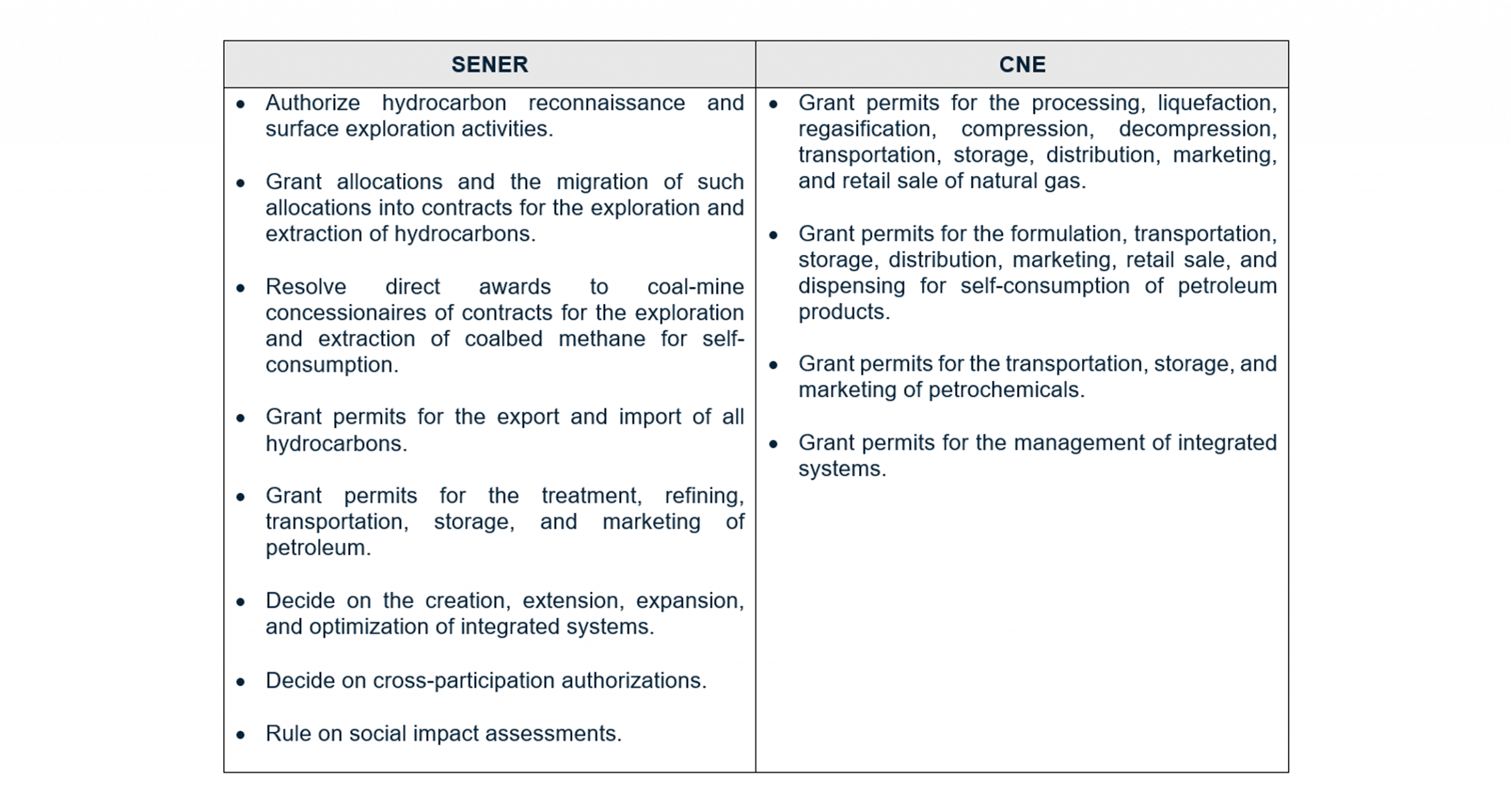
1.3. Permit Terms.
- The new Regulation also modifies the term of hydrocarbon-related permits, as previously all permits—except import and export permits—could have a duration of up to 30 years.
- Como ejemplos relevantes, ahora: todos los permisos nuevos de (i) comercialización tendrán una vigencia máxima de hasta 2 años, y (ii) de expendio al público de petrolíferos de 20 años.
- The Regulation also eliminates the possibility of renewing or extending permits; therefore, applicants must submit a new application and pay the corresponding fees.
- Attached hereto as Annex A is a summary of the updated permit terms.
1.4. Binding Planning and Social Considerations.
- The Regulations incorporates the concept of binding planning for the energy sector, which will be issued by SENER through general administrative provisions. This planning is aimed at developing strategic areas and projects that ensure, among other priorities: (i) the predominance of the Comisión Federal de Electricidad (Federal Electricity Commission; “CFE”), (ii) the promotion of decarbonization, and (iii) adherence to the principle of Energy Justice.
- Binding planning must be considered by SENER and the CNE when granting assignments, contracts, permits, concessions, and authorizations.
- The Regulation also includes the steps for the prior consultation mechanism that SENER must conduct with Indigenous peoples and communities when energy-sector projects—specifically in the hydrocarbons sector—are expected to directly affect their rights or interests.
2. Transitional Regime.
- Regulatory provisions issued prior to the entry into force of the Regulation will remain in effect until the issuance of the regulations that replace them. This includes, specifically, the agreements and general administrative provisions previously issued by the CRE and CNH.
- Likewise, all permits and concessions granted before the publication of the Hydrocarbons Sector Law and the Regulation will remain valid; however:
- Permit holders for the transportation, storage, and commercialization of petroleum, as well as natural gas processing, must update their permits once SENER and CNE issue the relevant guidelines.
- Permit holders whose permits expire between now and October 3, 2026 must file a new permit application under the new legal framework no later than January 1, 2026, unless the permit specifies a particular renewal period.
- Holders of commercialization permits will have until December 30, 2025 to provide operational information, including, in summary, quantitative and qualitative data, as well as a description of actions taken to comply with volumetric control obligations.
- Moreover, while proceedings and applications submitted before the entry into force of the Hydrocarbons Sector Law will continue to be processed, Article Fifteenth Transitory of the Regulation provides that all applications for authorizations, approvals, or permits must be resolved in accordance with the new regulations.
Although the Regulation states that “this provision is not retroactive because it regulates only procedural aspects,” this does not preclude affected parties from asserting legal remedies or arguments against procedural retroactivity to their detriment.
If you have any questions regarding the scope or implementation of this note, please contact us.
Bernardo Mendoza
Partner
bmendoza@k-g.com
Dorothy Lerch
Counselor
dlerch@k-g.com.mx
Gerardo H. Estrada
Attorney
gestrada@k-g.com.mx